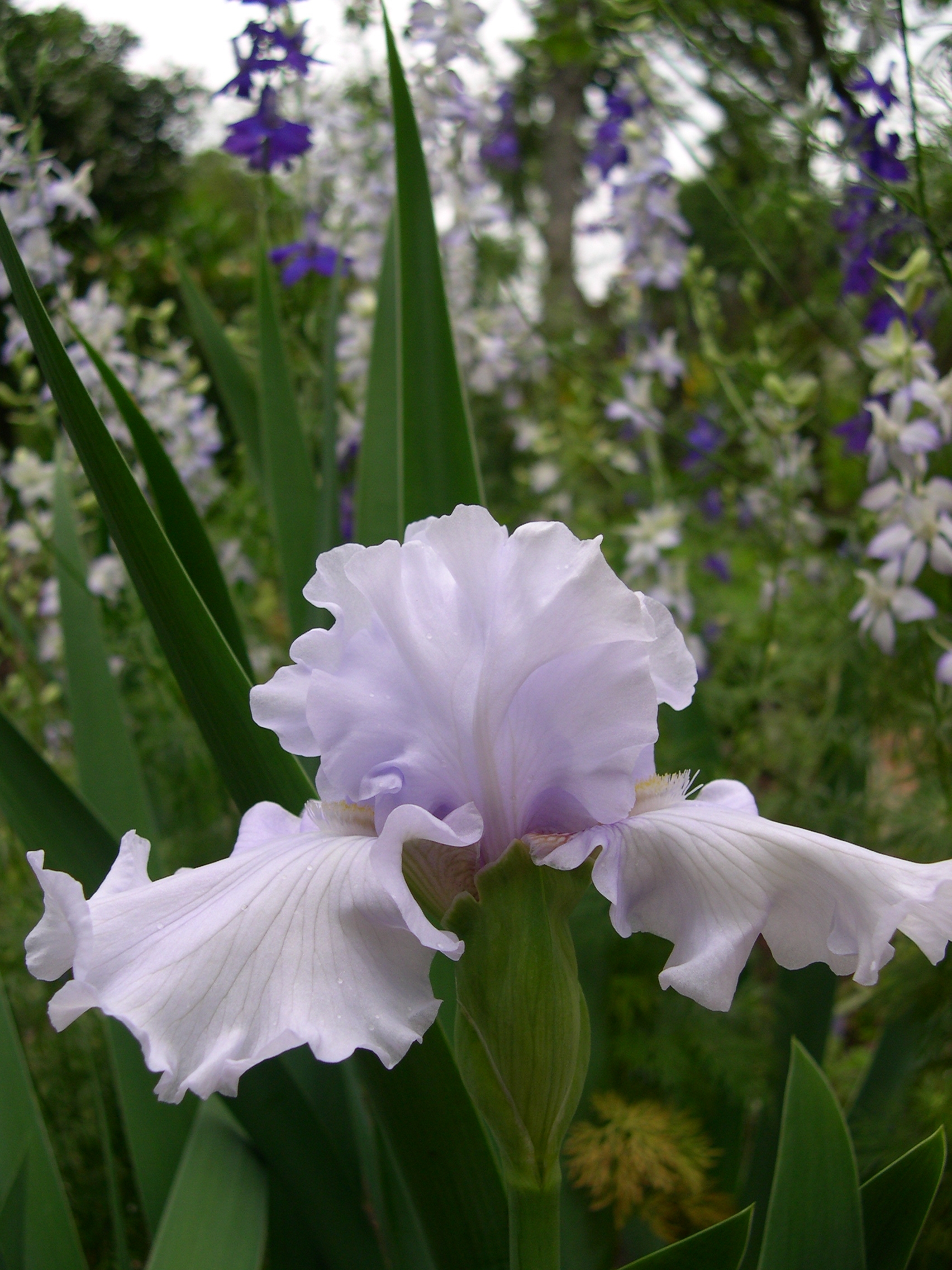
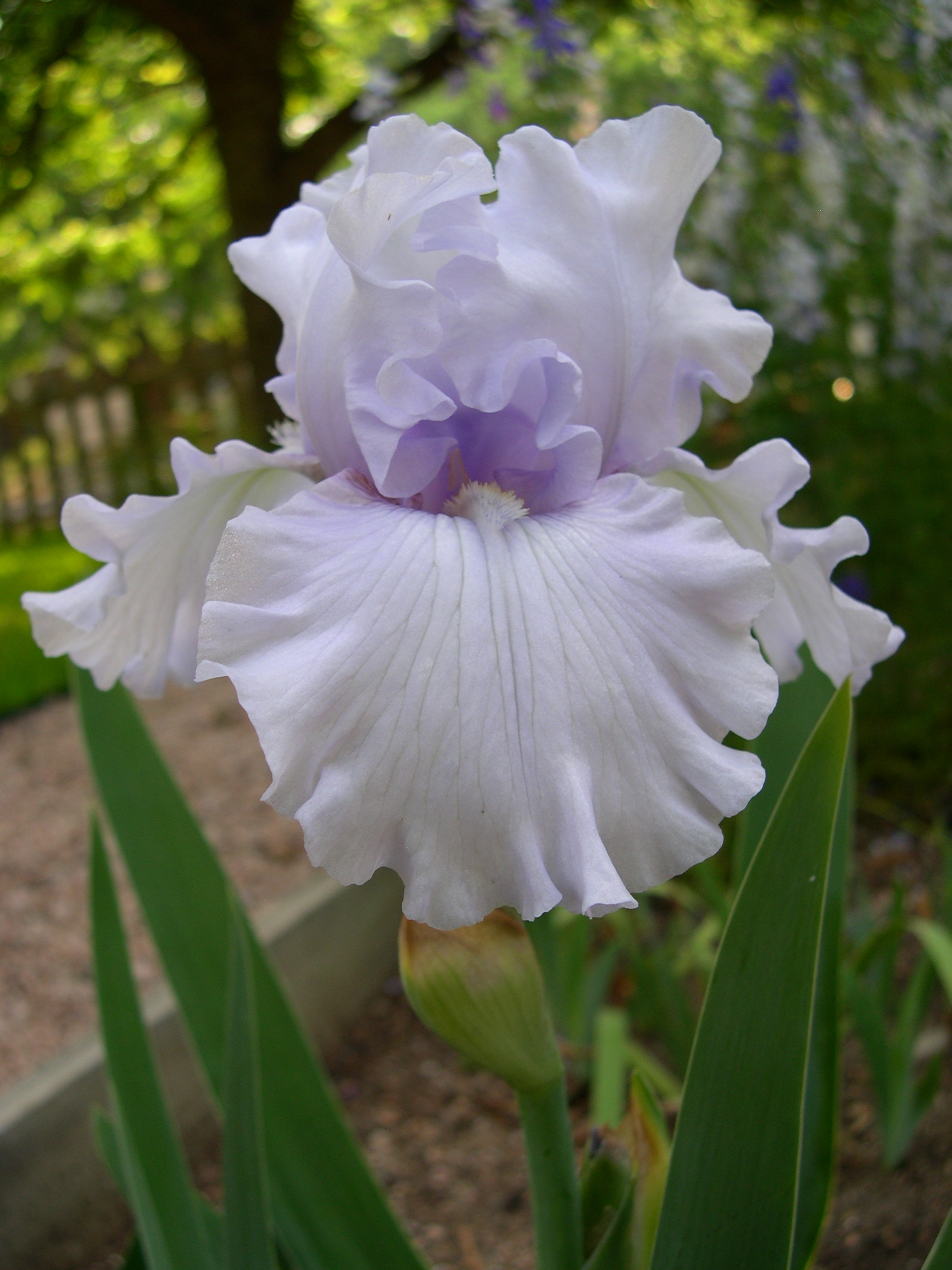
bearded iris Silverado
2004-05-06. Bearded iris ‘Silverado’ on a cloudy day.

May 6th, 2008
Iris ‘Silverado’

Two small stems of the bearded iris ‘Silverado’ bloomed for May Day. I want to say that ‘Silverado’ has never been very vigorous in my garden but photographic evidence contradicts me. Apparently I had quite a good stand of it in 2003 before I divided it and moved it. The three large rhizomes I’d bought from Schreiner’s Iris in 1999 had multiplied to 12 crowded small ones.

Schreiner’s bred ‘Silverado’ and introduced it to the iris world in 1987 where it took award after award, winning the highest honor, the Dykes Medal, in 1994. The color is the palest silvery blue with the slightest hint of lavender. The color glimmers in the mist or moonlight but washes out in glaring sunlight. The blooms are full and ruffled without the over-the-top frilliness of some modern irises. The standards and the falls are proportionately balanced.

Read the rest of this entry »

Hoedown at May Dreams Gardens
Since Carol @ May Dreams Gardens got her hands on her, there’s been no stopping this hoe. She wants to get down and get dirty with those Indiana hoes.

May 2nd, 2008
Pimpin’ My Hoe

Note: This post was written for today’s Hoe Down at May Dreams Gardens.

Like a faded wall-flower at the prom, my hoe is frequently overlooked and underappreciated. I prefer a garden fork and pruning shears for fighting my way through my root-laden clay. However, since Spring Fling, this hoe has been putting on airs. She had the thrill of a little one-on-one action with Carol, connoisseur of hoes, the hoe-stess with the mostest.

As I handed the hoe over to Carol’s capable hands, she eyed it critically. “Needs sharpening.” was her assessment.

“But how do you use it?” I asked, perplexed. “Do you dig with the pointy end? chop with the curved blade?” I want to pull it through the dirt like a plow blade but the angle of attack seems all wrong.

Carol slid her hand up and down the wooden handle, testing the center of balance. “Like this,” she demonstrated with a few smooth, easy strokes on the chipped bark path. My hoe’s finest moment. Carol looked around. “You don’t really have the right kind of garden for hoes. You need a vegetable garden. With rows.”

Unloved hoe. She knows her best days are behind her.

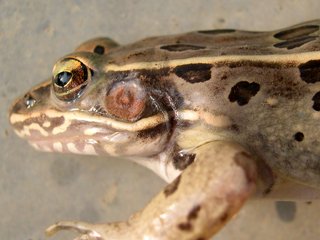
frog

May 2nd, 2008
Ode to Toad (or rather Requiem for a Frog)

AJM came in upset from his morning ritual of greeting the goldfish. “There’s a toad or something caught in the bird-netting and I think it’s dead.” I went to check and so it was. The poor thing had gotten its nose stuck in the netting and its own weight held just its nose under water and it drowned.

frog

Last night a second maker of ribbets joined the bullfrog. And then there was a distinctively different croak. Was it this frog? A Rio Grande leopard frog, Rana berlandieri perhaps. This one was large, (although I don’t know how frogs are measured), at least 4 inches from nose to anus not counting the legs.

frog

This is not the first time the bird-netting has caught something unintended. Durn raccoons. If it weren’t for the raccoons, I wouldn’t put the netting over the pond. If I take it off, then I chance waking to dead goldfish tomorrow. Is what differentiates humans from other animals the fact that all our interventions are fraught with anxiety? Or is that just a phenomenon of us city-bred moderns, we squeamish ones, who are out of touch with death?

Papaver Dorothy Cavanaugh passalong

May 1st, 2008
Week 18: May Day Pinks

Julie @ Human Flower Project passed along poppy seeds which finally started blooming this week. (Everyone else’s in Austin bloomed throughout April.) She said the double-selection was salmon. In soft early morning light it looked more dusty rose; in glaring afternoon light, definitely salmon. (These two photos are of the same flower taken about six hours apart.)

Papaver Dorothy Cavanaugh passalong

My love-in-a-mist, Nigella damascena had almost died out so, thinking I had enough blue flowers, I planted some ‘Mulberry Rose’ seeds from Renee’s Garden. The cilantro overgrew them and when I was clearing it out yesterday, I discovered these miniature nigella flowers, about the size of a dime, on teeny-tiny plants. (Seed packet: mature height 18-24 inches). Apparently they prefer room to grow.

Nigella damascena

On the opposite end of the scale, the unwieldy crinum (maybe Crinum bulbispermum) continue to flower. These large bulbs don’t like being moved and have taken about three years to settle in and start blooming.
Crinum

The pink rainlilies, Zephryanthes grandiflora opened all at once today. A single early flower opened on April 28th–but today is really rainlily day.

Zephyranthes grandiflora

“…have you become a farmer? is it not pleasanter than to be shut up within 4 walls and delving eternally with the pen? I am become the most ardent farmer in the states…I rarely look into a book, and more rarely take up pen. I have proscribed newspapers, not taking a single one nor scarcely ever looking into one. my next reformation will be to allow neither pen, ink, nor paper to be kept on the farm. when I have accomplished this I shall be in a fair way of indemnifying myself for the drudgery in which I have passed my life. if you are half as much delighted with the farm as I am, you bless your stars at your riddance from public cares.” — Thomas Jefferson to General Henry Knox, June 1, 1795

April 29th, 2008
Thomas Jefferson: The Garden and Farm Books

Robin Chotzinoff flattered me in her story on garden blogging, comparing my compulsion for note-taking and record-keeping to Thomas Jefferson’s. I mentioned he was one of my garden heroes and inspirations. I wish I were even half as thorough in my records as he.

Thomas Jefferson Garden and Farm Books

Luckily for us, he did not ever fulfill his resolution to entirely abolish pen and paper from his farm. Quite the contrary. He wrote in his garden and farm books whenever he was at home. I’m betting that if Thomas Jefferson were alive today he would be a garden blogger. He was curious about everything, passionate about gardening, and loved sharing what he knew and learning from others.

New varieties of plants thrilled him; his garden motto seems to be “Discovery”. The Americas were, after all, a whole new world of plants. Before sending Meriwether Lewis on the famous expedition he sent him to Philadelphia for nine months to study botany. In contrast to our century, where we keep lists of plants that have gone extinct under our stewardship, Jefferson was adding plants through discovery or hybridization. “The greatest service which can be rendered any country is to add a useful plant to its culture,” writes our third president and author of the Declaration of Independence.

Using the technology of his time, he wrote a copious number letters swapping knowledge and always begging seeds, bulbs and plants to try. “Your favor of the 7th came duly to hand and the plant you are so good as to propose to send me will be thankfully recd. The little Mimosa Julibrisin you were so kind to send me last year is flourishing.” he writes William Hamilton from Washington in 1806. In this same letter he lays out his plans for farm improvements when his term as president is over. “…my views and attentions are all turned homewards.” he prefaces several long paragraphs on his plans for farms when he gets home, concluding with, “…the subject runs away with me whenever I get on it.”

He is aware of the social obligation of his written connections. Correspondence, like blogging, establishes a relationship, one that must be kept up by both writer and reader. “In matters of correspondence as well as money, you must never be in debt.”

Doesn’t it humanize these great historical figures to know that in 1796 Thomas Jefferson wrote to George Washington saying, “I put away this disgusting dish of old fragments & talk to you of my peas & clover.” He then goes on in great detail talking about how many tons per acre of wheat he has grown, how tall the stalks are, how his older fields are exhausted, his plans for crop rotation, and how he’s built a Scotch threshing machine from a model someone sent him. He modified the plan to more easily move it from field to field.

In his travels to Europe, Jefferson is fascinated by farm methods and plant choices. He stops to ask a man why he is gathering ferns in the forest. When he hears the reply (he uses dry ferns to pack apples for market, as they don’t give off a scent as hay does), Jefferson can hardly wait to get home to try it himself. Americans have just recently gotten on the olive oil bandwagon, but Jefferson was promoting the olive in 1787.

“The Olive tree is the least known in America, and yet the most worthy of being known. Of all the gifts of heaven to man, it is next to the most precious, if it be not the most precious. Perhaps it may claim a preference even to bread; because there is such an infinitude of vegetables which it renders a proper and comfortable nourishment. In passing the Alps at the Col de Tende, where they are mere masses of rock, wherever there happens to be a little soil, there are a number of olive trees and a village supported by them. Take away these trees and the same ground in corn would not support a single family.”

Thomas Jefferson kept a garden book, primarily a calendar, from 1766 to 1824. Over the years his garden book became more detailed and exacting: records on the weather, on what he planted, on when he harvested, drawings laying out the garden beds. He noted the migration of birds and the dates of first flowers. Some of his notes read like tweets.

1811 Mar 16. planted 5. Tuckahoe grey cherries in the rows e-1-2-+1.4.5 from Enniscorthy
1811 Mar 18. planted Asparagus seed in beds 5.6.7. & replanted 3.4
1811 Apr 13. Quarantine corn from Thouin in the old Nursery.
1811 May 16. strawberries come to table.
1821 May 28. artichokes come to table. The last dish is July 28.

Jefferson had one of those minds that is never satisfied, a mind that is never still but constantly reaching for a more efficient way to do things. His farm books are filled with ideas and advice that he’s collected over the years and organized by topic as well as detailed farm management records. He records the progress on grading roads, writing down the number of people working and how much road they make each day and figuring the yards per day per hand progress. (Much slower going in the woods and uphill.)

And he is not content to read about an idea. He experiments, observes and records. Is it more efficient to use candles or oil lamps, he wonders and sets an experiment burning both a lamp and candles for 16 1/2 hours to see how much fuel is used.

…it appears that 1. gallon of oil will burn 402. hours, and that it requires 10 3/5 lb of candle to burn the same time so supposing oil to be .75 per gallon, it will be equal to mould candles at 7. cents per lb which shews the advantage of oil.

In 1793, when Eli Whitney writes to Jefferson about his little invention, the cotton gin, Jefferson immediately wants to know how he can employ it on his farm.

“…I feel considerable interest in the success of your invention for family use. Permit me therefore to ask information from you on these points. Has the machine been thoroughly tried in the ginning of cotton or is it as yet but a machine of theory? What quantity of cotton has it cleaned on an average of several days, & worked by hand, & by how many hands? What will be the cost of one of them made to be worked by hand?”

I love that phrase, “as yet but a machine of theory.” Apparently they had problems with vaporware even in Jefferson’s day.

One of my favorite letters is to Jacob Bigelow in 1818. Here Jefferson summarizes seven years of his observations that characterize the climate of Virginia. He includes average temperature and rainfall for each month, date of first frost (Oct 7-26), when the peach trees blossom (Mar 9-Apr 4), when the house martins appear, and the ticks! (both mid-Mar), when the lilacs bloom (Apr 1-28) and the fireflies appear (May 8). He also records that it is necessary to have fires at all times for four months in winter, and in the mornings and evening for another month before and after.

Do I know how many days of the year I run my heater, all day long versus only at night? How about the AC? How many nights did we have a hard freeze this last winter? Was that typical or less than average? Have I tried different fertilizers on my tomatoes to compare them and see which is the most efficient? How about different methods for tying and staking tomatoes? Is there a good reason that Austinites shouldn’t set out tomatoes before March 15th? What if they are in protected site? What if we use row covers?

How much advice do we take on faith without testing it ourselves? And how rigorous are our tests? Do we just follow advice without also growing a control to use as a comparison? Do we write down our observations and then compare our notes over several years and with others? How much practical and useful information are we collecting and sharing? How much of what we’ve learned through experience will be lost if we don’t pool our knowledge? Jefferson is an inspiration for seeking continual/continuous improvement.

Time to update my In Bloom Calendar for April.

Zanthan Gardens bog garden
2008-04-27. Taken after much of the water had soaked in…poor light and a dead camera battery kept me from getting a good shot of how it looked at its worst–the lawn was completely under water.

April 27th, 2008
Bog Garden Comes to Life

Imagining the bog garden is a much easier when we get a month’s worth of rain in about 15 minutes. Even without any roof runoff the holes I’ve been digging to collect water fill quickly. The water overflows into the lawn and is slowed temporarily by the berm before rushing around it and flooding the garage.

Note to self: dig deeper holes.

This morning’s downpour was intense. I cringe to see all that precious water running off. My rainbarrels were already full from the rain the other day.

Note to self: get bigger rainbarrels.

My rain-catching terraces are having some effect in slowing down the runoff. The amount of rain pouring off the place where the roof forms a valley by the front door looked like someone had opened a fire hydrant. I think it would have overwhelmed any guttering system. Must check to see how VBDB’s new rainwater collection system handled this storm.

rose Mermaid
Rose ‘Mermaid’ likes to climb trees and its large flat blossoms glow like little moons in the twilight.

April 26th, 2008
Welcome Statesman Readers

If you are stopping by for the first time because of the Statesman article on garden blogging, it’s nice to have you. Don’t be shy about joining the conversation. Bloggers love getting comments. If you are interested in reading about other Austin gardens, check out the links in my sidebar or the latest comprehensive list at Pam/Digging. Austin has more garden bloggers than any other city in the world!

While here, you can explore the archives by category: read the history of my garden both outside and online, check out what’s happening Week by Week, Month by Month, or my latest garden project gone bad. Although I like to try new plants, for some reason the post I receive most comments on is the one on Indian hawthorn–a plant I despise and ripped out of my yard.

Our motto here is research, research, research and then trial by error. Lots of error. If we learn best from our mistakes, I’m on the path to genius. The best thing about garden blogging is that we get to compare notes with other gardeners, people who understand our obsessions, encourage us through our losses, and cheer us on in our successes.

Stocker Garden
The strong underlying geometry of Jenny’s garden balances the exuberant plantings and keeps the garden from chaos.

April 20th, 2008
Inside Austin Gardens Tour 2008

I’m becoming more and more fascinated by people who make gardens–that is, in contrast to people like me, who merely grow flowers (and the occasional vegetable where sunlight permits).

I just realized that most of the gardens I’ve visited are private English estate gardens turned public, Hidcote Manor, Arley Hall, Tatton Park or civic gardens such as the instructive Springs Preserve in Las Vegas or the Japanese garden in San Francisco.

Japanese Garden San Francisco
Japanese Garden, San Francisco

These are gardens of extraordinary effort: to design, finance, construct, and maintain. As much as I love visiting these gardens, I don’t find lessons I can immediately apply to my garden. (The basic lessons in design are there, of course, but the scale of the gardens is such that it inhibits rather than inspires my creative urges.) I look at grand gardens the same way I do houses in Architectural Digest, admiringly yet outside my purview, beyond the range of possibility. I could never do something like that.

Yesterday I had the chance to visit the gardens of ordinary people. And when I say ordinary I do not mean it as a slight but as a compliment. Tremendous personal effort and vision went into each of the gardens I visited. My point is that these are personal not civic efforts. These private gardens were made by individuals, not teams of hired gardeners, by “plain folks” who transformed their typical city or suburban lots into extraordinary places. And just as encouraging, these gardens were built right here in Central Texas, gardens that suffer the same challenges of climate, drought, flood and scorching summers punctuated by thunderstorms, high winds, and hail as my own.

In short, these gardens excited and inspired me because they teemed with possibility. Maybe I could do something like that.

The tour was sponsored by the Travis County Master Gardeners Association and focused on sustainable gardening. The point we were supposed to take away, I think, is that sustainable gardening does not mean sacrificing pleasing design, beauty, or creativity.

Link’s Garden

Link’s garden is the closest to my own geographically in laid back south Austin. I’m guessing that most people will remember it as the “found objects” garden–an amazing collection of the mundane and the discarded reclaimed as garden art.
Davidson Garden
What’s a south Austin garden without painted tire planters? The unique touch is the cymbals on rebar sculpture.

What impressed me most was the creative use of space, the amount of garden packed into a tiny lot on a steep hillside. At the top of this narrow winding path, there is a deck with two chairs that look over the garden. The fence to keep you from stumbling over the edge is made from old seatless wooden chairs painted bright colors.
Davidson Garden
Rusting lawnmower as artistic statement in a garden where all the lawn has been torn out. And if you can’t grow barrel cactus in your climate, what about turbine fans?

Mary and Clark’s Garden

Mary and Clark’s garden astonishes on many levels. First it’s plopped right in the middle of bland suburbia…
Bakatsa Garden
…and stands out from its neighbors with an aggressively planted front yard herb and butterfly garden.
Bakatsa Garden

Mary and Clark have a completely lawn free yard. The house is topped with solar panels, they harvest rainwater, and have a huge compost pile. Way to go suburbia!

The length of back fence, a short fence providing little privacy with large bushes on the neighbor’s side seems like an impossible place to grow anything interesting. And yet roses bloom in what seems like too much shade and fruit trees line the path.

Bakatsa Garden

The garden celebrates edibles, providing food for the family with excess shared with neighbors and donated to charity. In addition to the all-season vegetable garden, Mary grows olive and apple trees and has harvested grapefruit from a tree grown from a seed. None of these trees are typically grown in Austin, which demonstrates that sometimes I need to break the rules and take more chances in my garden.

Bakatsa Garden

Walt’s Garden

Krueger Garden
Inviting entry. The garden is enclosed in the back away from the ravages of deer.

Walt’s garden, Serenity, is a collector’s garden. His plant list numbers over 300 and most of them are shade plants…just the kind of inspiration I need. Although he has lived in the house for over 20 years, building the stonework retaining walls and pathways really began when he retired in 2001. He terraced the entire hillside by hand, mixing concrete in a wheel barrow. He said that he was strongly influenced by Japanese gardens and it shows. Rather than relying on the flashy color of annual flowers for interest, Walt focuses on the textures and shades of green. The variety in Walt’s garden comes from the sheer number of different plants in his vast collection.

Lesson learned: I should stop complaining about my shade and do something with it.
Krueger Garden
Serene green refuge from an Austin summer.

Jenny and David’s Garden

Taken as a whole, Jenny and David’s garden borders outside the range of my potential. I can’t imagine a huge walled garden on my lot no matter how much I’d love to have one. However, if I could have any garden in the world, this is probably the garden I would want. It is the perfect blend of my mother’s New Mexican adobe house dreams and AJM’s mother’s English cottage garden. And it feels familiar because I love and I grow many of the same plants.

Stocker Garden

Because Jenny and David’s garden is divided into smaller rooms, it never overwhelms or seems inaccessible. Each room has such a friendly atmosphere that I can imagine just sitting and being almost anywhere here.

I took AJM to see the paving stone courtyard…David poured the concrete pavers himself. “See. We could do something like that.” I nudge AJM, encouragingly. “Couldn’t we?”

Stocker Garden


2008-04-20. rose ‘Mermaid’.

April 20th, 2008
rose ‘Mermaid’

This rose was a lovely monster. It climbed trees looking for light but it never found enough of it. It would die back but then struggle to send out new shoots each spring. Its huge flowers glowed in the moonlight. I miss it and regret that I couldn’t give it a sunny spot in my shady yard. It deserved better.

photo: iris Champagne Elegance
2008-04-17. Bearded iris ‘Champagne Elegance’.

April 18th, 2008
Iris ‘Champagne Elegance’

Dateline: 2008-04-18

Did I move ‘Champagne Elegance’ as I chided myself to do in 2004? Why is my record-keeping so inconsistent? No, I chopped out the oregano instead. I had already moved her to the east square of the front lawn, a sunny spot where my plan was to plant roses and irises so that I could keep all the demanding plants together. The nearby Texas mountain laurel and oleander grew so quickly that this planned sunny spot was completely in the shade last year. So go my plans. As do my dreams of hundreds of irises multiplying exponentially.

Still ‘Champagne Elegance’ struggles on. Last year, Austin got twice as much rainfall in the summer as normal and I lost many bearded irises to rot. Only one rhizome of ‘Champagne Elegance’ survived. It produced three babies, each of which sent up a stalk and began flowering yesterday. Six small flowers in all. This is not a very impressive showing in the realm of tall beard iris fanciers but it pleases me.

Aren’t there certain flowers in your garden that make you run out when you spot them and whoop for joy? “Look! There’s ‘Champagne Elegance’ again’,” I insist, showing anyone who will stop and look.
Read the rest of this entry »