Our first perfect fall day.
Yesterday, I woke up with a splitting sinus headache, my personal harbinger of rain. In the morning, it drizzled on and off. In the afternoon, we had a nice rain.
This morning when I went outside, I was surprised by a shock of cool, dry air. The first cool front of fall had blown in and the temperature had dropped ten degrees (though the low humidity made it feel even cooler). What a glorious day! The sky is a vivid blue and it actually feels good to be outside.
I had no choice but to spend the day gardening.
Category: Week by Week in the Garden | Comments Off on Week 37: Glorious

2002-09-09. Oxblood lilies and garlic chives blooming in the stump garden.
I began the stump garden on April 29th of this year to solve several other problems. First, I needed to move bulbs from an area which I had used as a nursery but which is slated to be a patio. I decided to move them to a wild spot under a cedar elm tree on the edge of the lawn in the back. That spot is too dark for most wildflowers and the shallow roots of the cedar elm suck moisture and nutrients from the ground, making the soil very poor indeed. Worse, the site is on a slope, so the water tends to runoff rather than soak in.
The other problem was I have a lot of bits of sawn tree trunk leftover from the tree which fell on our garage last November. I decided to use some of these pieces to create a structure on the slope and plant bulbs and other shade-loving plants between them. I placed the tree trunks close enough together that I can jump from one to another to water or weed. Then I planted garlic chives and oxblood lilies which bloom together in the fall; the rest of the year the garden would be various textures of green from palm grass, liriope, monkey grass, and ferns.
Last weekend our first fall downpour, a gift from tropical storm Fay, caused all the oxblood lilies to burst into bloom this week. The effect is better than I ever hoped it would be. But although the flowers will fade in a week or so, the arrangement of stumps provides a structure that has made this little garden pleasant all summer.
Category: Garden Essays | Comments Off on The Stump Garden
“Once begun is half done.”
August 2nd, 2002
Weeding
I didn’t spend much time in the garden in July. We had enough rain during the first couple of weeks that I didn’t need to spend every morning watering. Then we were away on vacation. Although the garden looked like a jungle before we left, I was unprepared for the explosion of green that greeted us on our return. Other than immediately mowing the lawns, I avoided going into the garden all last week.
Like many of life’s overwhelming tasks, weeding is best tackled a bit at a time, but with consistent effort. I figured that the yard has done allright without me for over a month, so rather than be distracted by the massive amount of work to be done, yesterday I started weeding just one bed.
I worked at it an hour and then quit. Today I did the same on the bed adjoining. A wonderful feeling of accomplishment comes of controlling the weeds in two small spaces. Tomorrow I’ll do another.
Category: Garden Essays | Comments Off on Weeding

2002-07-15. The meadow.
In a typical summer, the six weeks following Independence Day is season special to the south that I call “the Dead of Summer”. Until autumn rains sweep up from the Gulf (beginning the last week of August when we’re lucky) our gardens are at their bleakest. Temperatures top 100 degrees. Rain is nil. Although the 100 degree days average ten a summer, in 1991 we had 40. And rains never came. Ditto 1990.
Read the rest of this entry »
Category: Week by Week in the Garden | 1 Comment »
Plant Profile: Allium sphaerocephalon

June 2, 2002 Austin Texas zone 8

June 5, 2002 Austin Texas zone 8

June 5, 2002 Austin Texas zone 8

June 11, 2002. As the drumsticks fully open they develop the shape that gave them their name.
The drumstick onions take forever to unfurl. I’m always disappointed in the beginning and then end up being won over by their odd charms.
From the catalog description: Deep pink-reddish flowers. Height 32 inches. Late spring flowering. Plant 6 inches deep and 3 inches apart.
Zanthan Gardens History
1998-11-24
Planted the ornamental drumstick onions that I purchased from Dutch Gardens.
1998-12-01
Sprouted. (About 1 week).
1998-12-13
Rapidly attained a height of 10 to 12 inches with dark, straight, narrow leaves. They have a much neater habit than the A. neapolitanum and for that reason, I prefer them in the meadow. However, they weren’t supposed to bloom until late summer or fall. I was hoping they would replace the larkspur, But they are up before the larkspur and I might have to pull any larkspur I planted there so that it doesn’t compete and overshadow them.
1999-05-05
First flowers. On stems 30 to 36 inches tall. They tease for a long time in bud, then lose a papery case around the flowers and turn a lovely reddish-purple from the top down. They are very strange-looking and I like them.
2002-06-13
This year the first flowers began well after all the spring annuals had faded. Supplemental watering has lengthened the bloom period and resulted in larger flower heads.
2002-10-29
Dig up one clump that was weedy and divide and replant it. The leaves are about 8 inches long and the roots are well-established, but they didn’t seem to mind the transplanting very much.
Category: Plant Highlights | Comments Off on Allium sphaerocephalon
A Garden from a Hundred Packets of Seed
James Fenton
Farrar, Straus and Giroux. New York. 2001
Just as I’m beginning to take garden planning more seriously, just as I’m installing more hardscaping and thinking about garden bones, just as I go in search of a shrubbery, I pick up this little book which says, more or less, “Forget design. It’s about the flowers.”
This book is not so much about gardening as it is about the game of lists. If your garden was a blank slate, if you could plant anything you wanted to grow (but only if you grew it from seed), what would you plant?
I’m not sure I can even come up with a 100 plants to grow from seed at this point in my gardening career. I’m not very good at raising things from seed. But, I’ll have a go at making a list of my own. Why don’t you add a comment and tell me what you would grow.
Read the rest of this entry »
Category: Garden Book Reviews | 1 Comment »
The problem with borrowed views is that you have no control over them.
Any gardener with a small garden learns to borrow visual elements in the landscape beyond the garden’s borders. When I look up from my desk, the path through the meadow leads my eye to the trunk of a huge live oak tree in the yard behind mine, and to the screen of mixed green shrubbery beyond. In front of the chainlink fence, I’ve planted a mix of flowering shrubs that disguises the boundaray rather than a hedge that would call attention to it. This creates an illusion that the back yard is twice as deep as it is. The neighbor has a old stucco outbuilding that complements the scene.
Read the rest of this entry »
Category: Garden Essays | Comments Off on Borrowed Views
Four days after we received an inch of rain, the rainlilies open.
Category: Plant Highlights | Comments Off on Rainlilies
Pleasure of an unexpected rain.
In Austin, it’s just not a Memorial Day weekend without some severe weather. Having been cheated out of the last two predicted chances for rain, I didn’t even look at the forecast. Then at 1:11 AM, I was awakened by pouring rain and thunder. It rained for a good twenty minutes, resulting in more than an inch of rain. I got up, just to go outside and smell it.
This morning, the rain barrel is full and the entire yard looks fresh again. The rain sifts through the sand of the new paths and makes them even and clean. All the mulch I spread yesterday is also evenly sifted over the beds. The smell of the damp earth is intoxicating. Best of all, there is a chance for more rain this afternoon.
Category: Weather | Comments Off on Wow! Rain!
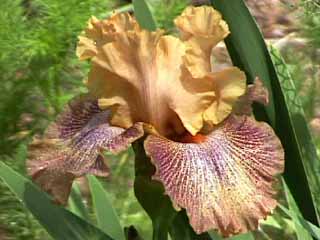
Bearded iris ‘Sneezy’
Sadly, ‘Sneezy’ bloomed in my garden only once and then disappeared. Experiences like this persuade me that I’d be better off just forgetting the garden and buying cut flowers instead.
Category: Plant Highlights | Comments Off on Iris ‘Sneezy’


