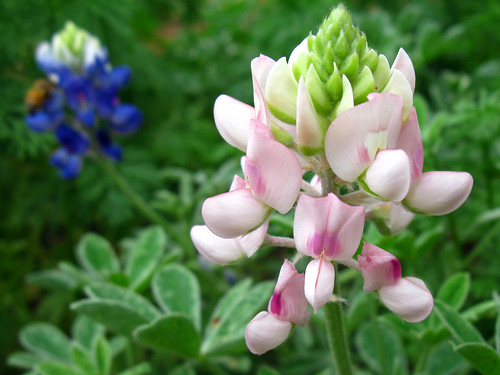
Pink Bluebonnet
Delicate pink bluebonnet–a natural variation.

March 7th, 2009
Pretty in Pink

Last October I posted about how certain lurid fall pinks made my skin crawl. Those pinks were so intense, so clashing, and completely out of season. In my mind Autumn belongs to the brilliant yellow, orange, and red spectrum.

You might have concluded that I’m the kind of girl who shies away from pink. Although I do gravitate towards black, whites, and grays, I can embrace pink if it’s icy pale and delicate and in its season: Spring.

For example, I never get tired of photographing the gorgeous ‘Souvenir de la Malmaison‘.

rose Souvenir de la Malmaison

And this year, after a 10-year hiatus, I made another attempt to grow ‘Angelique’ tulips. They are struggling in our run of 80-degree days but one flower has opened and I think they’re worth the effort.
tulip Angelique

hole
2009-02-27. The frame is 3’x5′. The hole itself is 2’x4′ and about 20″ deep. Less than 2 feet! If you expected me to dig my own grave before you killed me, we would be here for several years.

March 4th, 2009
Digging Holes for Raspberries

The north boundary of my back yard was one of those areas I used to ignore. A waist-high chain link fence divided me from my neighbors and the previous owners had planted a nandina hedge. I left it because it provided a nice green backdrop with no effort and it blocked the view of my neighbor’s back yard. When someone new moved in he immediately erected a 6-foot tall privacy fence and completely changed my garden.

Now the north bed is protected from cold fronts moving in from the north. The low winter sun shines against the fence all day creating a warm micro-climate. Last year I had a chinaberry and hackberry cut down and planted two roses and made a little herb garden here. This winter I decided to tackle another section.

hole
2009-02-06. The requisite “before” photo.

First I had to remove the nandina. You can cut it to the ground and nandina will come back because it has thick fibrous roots. While I was doing this, I happened across some raspberries at The Great Outdoors. Now raspberries are our favorite fruit. When we visit AJM’s parents in England, I go out every morning and graze at the raspberry patch. But raspberries don’t grow in central Texas. Central Texas is too hot in the winter, too hot in the summer, doesn’t get enough rain, and the soil is limestone clay. Raspberries prefer a sandy, well-drained, slightly acidic soil with plenty of humus.

Are you laughing yet at my folly? Or are also you one of those gardeners who can’t resist a challenge? The nurseryman assured me that these ‘Dorman’ red raspberries could stand our southern heat. If that’s true, then I’d do my part to provide them with the kind the soil they like.

So to digging.
hole
Roots, limestone and flint, and a vein of red clay.

Actually, you can’t really call it digging because that implies putting a shovel into the ground and scooping dirt out. What I did was break up clods of clay with my post hole digger (Vertie, can explain why this is preferable to a pick-ax), and then use my pruners to cut away roots. Repeat. Repeat. Repeat.

This took almost two weeks, working a few hours a day until I collapsed from the back pain. Thank science for ibuprofen. After the first week, I thought the hole was pretty well dug. I put some water in to check the drainage. It didn’t drain. The water sat there for an hour over solid clay. By the next day it had seeped and the clay was softened enough that I was able to dig it out.

hole
I pile a wheelbarrow load of red clay by the driveway.

Job 2: Fill in the hole. It’s a little more than a cubic yard (see photo at top). With some planning I suppose I could have had some garden soil delivered. Maybe next time. I line the hole with weed-blocking cloth. I have poured tons of manure and bought soil into my yard and learned that without weed-blocking cloth the tree roots quickly invade and suck all the life out of the garden soil. If I didn’t use weed-blocking cloth, the hole would revert to the root-infested muck it was before I spent two weeks digging it out.

A neighbor of mine with a goat has given me a wheelbarrow load of goat pellets mixed with straw and juniper needles. I pour that into the bottom of the hole.

Unfortunately, the compost from the compost tumbler is not quite ready yet. But I can turn the open compost pile and sift out the good stuff from the bottom. I use the plastic trays from the nurseries to sift compost.

hole

I mix the homemade compost with free coffee grounds from Starbucks. I also sift the rocks, roots, and clods out of some of the better black soil that came out of the first five or six inches of digging.

hole

As the hole fills in I begin to mix in some premium store-bought compost: Lady Bug Hill Country Garden Soil and Lady Bug Farm Style Compost (cow manure from grass-fed cows). Fancy schmancy, I thought until I compared it with the cheaper cow manure from the big box store. The latter was filled with clay and rocks and did not have the light fluffy texture that the Lady Bug brand has.

I moistened the planting mixture every few inches soil that everything in the hole would be evenly moist (like a damp sponge). Since I did this over several day it also helped it to settle a bit. I place the still-pottedplants where they’re going to go and fill in around them.

hole

AJM built the raised bed from pieces of the failed garden house.

Finally planting takes all of two minutes to pull the pot out of the hole, slip the plant out of the pot, and put it right back in the hole. (They are very young plants and not pot-bound so the roots didn’t need spreading out.)

hole
The “after” picture. I sifted some of the red clay to put around the outside. It almost has the consistency of decomposed granite–which it might be given that I pulled out quite a few red rocks.

The raspberry planting project is not quite finished. AJM is going to build some supports. I still have to add a layer of mulch. I don’t know if raspberries will grow in Austin but I’ve given it my all. If it doesn’t work out, this will be a great bed for potatoes or other root crops.

Project Cost

$29.97: plants: 3 raspberry canes @ $9.99 each
$ 5.99: 1 cubic foot of Lady Bug Hill Country Garden Soil
$ 6.99: 1.5 cubic feet of Lady Bug Farm Style Compost
$ 4.96: 2 pack 4″ mending plates @ 2.48 each (building the raised bed)
_____
$47.91

Note: We already had the lumber and the weed block cloth.

photo: Prunus Mexicana Mexican plum
Prunus Mexicana. The greenish small ones. Austin. 2009-02-26.

February 28th, 2009
Prunus mexicana

Recently a reader asked me how many years it takes Mexican plums to start blooming. Of course, as with all garden answers, it depends. Looking back on my records, I see that it took a good 5 to 7 years for the ones I planted to start blooming prolifically. My trees came in 1-gallon pots and were probably only about 5 or 6 feet tall when I got them.

My Mexican plums are understory plants. They receive plenty of sunshine from November until they bloom in February but are in the shade of large cedar elms the rest of the year. I do not provide them with supplemental water now. I did water them some the first two or three years in the worst of the summer heat. Typically their leaves look a bit ratty and forlorn by August.

Dateline: 2006-03-04

My two smaller Mexican plum trees are covered in a froth of white blossom this week. I planted them in 1995, but it’s been only in the last two or three years that they have created the effect I originally envisioned–a solid white foam of flowers. I was inspired by the trees in my neighbor’s yard and this year almost all our trees are blooming together which is just what I imagined.

I also have a larger Mexican plum which I bought from Gardens. I think they must be slightly different varieties. The larger tree is has formed a large oval shape while the two smaller trees spread and almost weep. The large tree doesn’t flower as heavily, even though it is an older, much bigger tree. The flowers have a tint of rose at their throats; the flowers on the two smaller trees are tinted green.

photo: Prunus Mexicana
Prunus Mexicana. The pinkish large one. Austin. 2006-03-01.

Mexican plums are intended to be ornamental. The large tree bears ume-sized plums which are mostly seed, fit only for birds. I’m tempted to try making the Japanese liquor umeshu.
Read the rest of this entry »


‘Persimmon’ (possibly the best tomato I’ve ever tasted) and ‘Black Krim’ (which I figure prefers cooler climates).

February 25th, 2009
In Search of the Perfect Tomato

I used to be more successful growing tomatoes than I am now. I even used to grow unusual varieties of tomato from seed, starting them on top of my computer monitor in my office (excellent source of bottom heat). Now I work at home, my computer has a flatscreen monitor, and I barely have enough sunlight in my yard in the summer to support 5 tomato plants. So rather than start my own tomatoes from seed, I find it cheaper to pick up a half dozen plants from a local nursery. I’ve found that in Austin, the best source of unusual and heirloom varieties (the kind I would have grown from seed myself) is Gardens.

I don’t have much room to play so I want every tomato I grow this year to be something special. Gardens provided their list of tomatoes (see below) and I’ve spent the last week researching them, trying to decide which ones to try this year. I was hoping for some good information from the garden blogosphere–I think this is precisely the kind of information in which bloggers could outdo print garden publication. But for the most part I’ve been disappointed.

Hands down the best garden blogging resource for tomato reviews I’ve come across is Hanna’s Tomato Tastings at This Garden is Illegal. For the last three years Hanna has grown a variety of unusual tomatoes and written extensive reviews of her experience. If you’re looking for tomato suggestions, start there.

Maybe I’ve just overlooked your brilliant tomato review. If you’ve written a post on any of the following tomatoes, or have recommendations for or against, provide a link and I’ll add it to this post. If you didn’t blog about it, just share your experience in the comments.

Help me find the perfect tomato.

Leucojum aestivum summer snowflake

February 24th, 2009
Leucojum Aestivum

I inherited the summer snowflakes with my garden and they’ve grown very dependably these last 15 years without any effort on my part. Unlike many bulbs they don’t mind “wet feet”. With central Texas currently the most drought-stricken spot in these United States that might not seem like much to recommend it to the Austin grower but what “wet feet” means in garden speak is that summer snowflakes won’t rot in clay soils with poor drainage.

Mine are just the plain summer snowflakes with little flowers the size of thimbles. Last fall I planted the selected ‘Gravetye Giant’ summer snowflakes. I got them in a bit late and they’re just now coming up.

Summer snowflakes are always blooming in February in my Austin garden, this year opening on Feb 9th (with supplemental water). The earliest I’ve had them is Jan 29th and the latest Feb 22. They won’t last long this year though. They melted last Wednesday (2/18) when the temperature hit 80. It was 83°F today and will stay in the 80s the rest of the week.

In his Garden Bulbs for the South, Scott Ogden says, “In their homes around the Mediterranean these bulbs grow in mucky soils along streams. In such a situation they prosper on a surplus of spring moisture an a long summer baking. This prepares the flowers for the heavy cotton soils of the South.” However, from Louise Beebe Wilder’s description, in Adventures with Hardy Bulbs, I’d never have guessed they’d do so well in Austin. “[Summer snowflakes require] well-drained soil, not too dry and devoid of fresh manure…[They] should be set where the soil is never bone-dry and where it receives only the morning sun, on springy, half-shaded banks, in low woodland, in fern borders, or naturalized by the waterside. It thrives well even in heavy shade.”

I’ll have to agree with my neighbor, Scott, on this one.

rose Souvenir de la Malmaison
2009-02-15. Austin, TX. Rose ‘Souvenir de la Malmaison’. Although it has bloomed this early a couple of times before, typically it first blooms in March.

February 15th, 2009
GBBD 200902: Feb 2009

Carol at May Dreams Gardens invites us to tell her what’s blooming in our gardens on the 15th of each month.

Feb 15, 2009

Austin is now in its 18th month of drought. We are currently the most drought-stricken area of the country. However earlier this week we got almost an inch of rain over two days and the plants (including the weeds) have responded like young children on Christmas morning. They’re running wild.

Austin’s had quite a few days this last month with high temperatures in the 70s and even the 80s. Sometimes it would freeze overnight and then shoot up to the mid-70s by afternoon. Although other Austinites have had killing freezes hit, Zanthan Gardens is close enough to the heat sink of downtown Austin that it has flirted with freezes but not succumbed. Several flowers have cold damaged leaves but continue to bloom: the butterfly weed, the lantana, and the Mexican petunia.

ruellia Mexican petunia
The leaves of the Mexican petunia are bronzed with cold-damage but the plants keep flowering.

Also the big vines, duranta and Port St. John’s creeper continue to bloom from last summer. In a more typical Austin winter these freeze down to the ground but are root hardy. On the one hand it’s nice to have continuous flowers; on the other, the plants look shabby with last year’s ratty growth. I’d sort of prefer to have a fresh spring look. At least I feel more tolerant of the bright pink flowers of the Port St. John’s creeper in the spring; they seem so wrong to me in the fall.

New for February

I know Kathy @ Cold Climate Gardening finds it interesting that not only do we Austinites grow paperwhite narcissus outside in the ground but that sometimes they bloom at the same time as the roses. Here’s an example.

Narcissus papyraceus Grandiflora
Paperwhite narcissus ‘Grandiflora’.

If it weren’t for Carol @ May Dreams Gardens and her Garden Blogger Bloom Day, I would never have taken a closeup of an arugula flower or noticed its incredible markings. I can’t see them with the naked eye.

arugula

Jerusalem sage has been very dependable throughout the drought. I haven’t lost any plants and I also find it easy to propagate by sticking cuttings in the ground. This year it’s blooming more than a month earlier than it did in 2007 or 2008.

Phlomis lanata Jerusalem sage

Mexican plums are the first trees to flower in my garden. I think I have two different varieties because one I bought from Gardens always blooms two weeks before the other two I bought from Barton Springs Nursery.

Prunus mexicana

Spiderwort used to be one of my favorite wildflowers. It’s very aggressive, though, so now I try to restrict it to the more “woodsy” parts of the yard.

Tradescantia spiderwort

A relative of spiderwort is setcreasea (aka purple heart or wandering Jew). In the north, people grow it as a house plant (I think) but in Austin we grow it outdoors. It will freeze back. I usually pile leaves on it before a freeze. I haven’t done that this year and it looks a bit ratty but it’s keeps growing and blooming. I have the purple one with a bright pink flower and also this green one with a pale pink flower.

Setcresea

The leatherleaf mahonia and redbuds started blooming since the last GBBD, but I didn’t manage to get photos today. The rose ‘Ducher’ (which often blooms in December or January) put out a couple of blooms but neither was very photogenic.

Between GBBDs

Several flower bloomed and faded in my garden between GBBDs and so didn’t show up in the inventory for either January or February.

  • Crinum bulbispermum (milk and wine crinum in meadow)
  • Amaryllis ‘Black Pearl’ (in pot)

Complete List for February 2009

The list of all plants flowering today, February 15th 2009, at Zanthan Gardens. I’ve added the date that each started blooming if I knew it. I’ve also noted if the plant was blooming on GBBD February 15th, 2008.

  • 20080404 Duranta erecta
  • 20080902 Asclepias curassavica
  • 20080902 Podranea ricasoliana
  • 20081219 Lobularia maritima ‘Tiny Tim’, sweet alyssum (2008)
  • 20090107 Lonicera fragrantissima
  • 20090113 Narcissus tazetta x italicus (2008)
  • 20090205 Prunus mexicana (the large one from Gardens) (2008)
  • 20090206 Narcissus papyraceus ‘Grandiflora’ (2008)
  • 20090206 rose ‘Ducher’
  • 20090206 Mahonia bealei (2008)
  • 20090208 Narcissus tazetta ‘Grand Primo’ (2008)
  • 20090209 Leucojum aestivum, summer snowflake (2008)
  • 20090209 Cercis canadensis, redbud
  • 20090209 Lantana montevidensis (2008)
  • 20090211 Coriandrum sativum, cilantro
  • 20090212 Eruca sativa (arugula)
  • 20090213 rose Souvenir de la Malmaison
  • 20090213 Phlomis lanata, Jerusalem sage
  • 20090215 Tradescantia, spiderwort
  • Lavandula heterophylla ‘Goodwin Creek’
  • henbit (2008)
  • Pisum sativum ‘Green Arrow’ (English peas)
  • Polanisia dodecandra, clammy weed
  • Setcreasea pallida
  • rosemary (2008)

Zanthan Gardens Week 6 Narcissus Grand Primo
2000-02-11. Narcissus tazetta ‘Grand Primo’.

February 12th, 2009
Week 06: 2/5 – 2/11

Dateline: 2009

I associate the first redbud blossom (my private official marker of spring) with Valentine’s Day but this year I saw my first redbud on Monday (2/9), almost a week early. Spring’s in Austin and there’s no holding it back.

As my son retorted, “Does this mean we’re going to have a month of 70-degree days and then a hard freeze during Spring Break?” Probably. Austin’s average last freeze is now February 26th (it used to be in March) so the period between Valentine’s Day and St. Patrick’s Day is always a bit chancy for tender new plants. He’s probably remembering when he was a boy and I took him camping at Enchanted Rock for his birthday. The temperature surprised us by dropping to 14 degrees that night. That was the same year as the latest freeze on record, April 3, 1987. As the Austin Climate Summary shows, Austin can be in the 90s or higher ANY month of the year; it can also freeze anytime between October and April.

Flowers were opening all over the garden. This is the most excitement we’ve had at Zanthan Gardens in about eight months.

First flowers: Prunus mexican (2/5); paperwhite Narcissus ‘Grandiflora’ (2/6); rose ‘Ducher’ (2/6); Mahonia bealei (2/6); Narcissus tazetta ‘Grand Primo’ (2/8); Leucojum asestivum (2/9); Cercis canadensis (2/9); Lantana montevidensis (2/9).

We had a bit of relief from the drought this week, too: about half an inch of rain in a slow, soaking drizzle on Monday (2/9) and then a bit less late in a 10-minute downpour (accompanied by high winds and hail) late Tuesday evening (2/10). The rain penetrated the first 4 to 6 inches of soil (depending on where it is in my yard–heavy clay or well-composted). Below that, the dirt is dust dry. It’s frightening to dig into it. I expect the spring weeds to kick into high gear now. Our weather has been so dry that even the chickweed was languishing. Some henbit has been blooming. I never weed it all out because the butterflies like it when nothing else is blooming.

I have been digging out nandina to make a bed for three raspberry plants I bought at The Great Outdoors. I didn’t think that raspberries would grow in Austin but they assure me that this variety, ‘Dorman’, will produce in a couple of years. We harvested an actual serving for two of the English peas and have been eating lots of salad trying to get the most out of the arugula before it bolts.

Read the rest of this entry »

I missed the RSVP date over at Veg Plotting but I’ve remained intrigued by the challenge to host an imaginary dinner of famous gardeners. Of course, we’d have to go out to eat. If I were worrying about dinner, I wouldn’t be focused enough to enjoy my guests.

February 11th, 2009
Conversations with Very Important Gardeners

After several days of pondering, I came up with my wish list.

Thomas Jefferson

Any longtime reader would have guessed that Thomas Jefferson would top my V.I.G. (Very Important Gardener) list. In his day America was truly a New World, a seemingly unbounded world filled with more unknown plants than a science fiction novel. Jefferson’s enthusiasm for exploring the novel was bounded only by his sense of the practical. He was a pragmatist who wanted to know the best varieties, the best methods of cultivation, and the best tools for improving yields. He envisioned a nation of small independent farmers who would be educated in schools dedicated to agriculture. Curiosity tempered with extensive record-keeping and a desire to share knowledge (as well as learn from others) makes Jefferson a person I’d want to listen to, in any type of gathering, whatever the focus of conversation.

HRH Prince Charles

Prince Charles seems a perfect foil for Thomas Jefferson. Both, heads of state. Both, avid gardeners. Evidently environment shapes the gardener and the contrasts in their times and environment are stark. Rather than Jefferson’s unexplored unknown (and its accompanying air of expectation), Prince Charles reigns in a small, island nation in a time where population growth has paved over farmland and gardens with subdivisions, highways, and malls, where (in terms of space and species) the world seems to be contracting. His focus is on conservation in all its myriad definitions, a desire to preserve the diversity of life on this planet before it is irretrievably lost. Whatever the differences, I think both men share a certain weariness with being “head of state”. At the end of the day, in their writings, both have expressed a strong desire to just step away from the public spotlight and get back to the garden.

Karel Capek

Some people speak in thin volumes but their every word is a treasure. I think Karel Capek belongs in this tribe. In 1931 he wrote a little book, The Gardener’s Year. It seems like a light read but, if you are a gardener, every sentence is so, so true. Whenever I see a pile of leaves lying by the side of the road being wasted, I think of Capek and how he longed for the strength to ignore public ridicule and sweep up after the horses in the street rather than let the precious manure go to waste. Nor do I ever struggle and curse a hose or breathe deeply the scent of the good earth (eschewing the showy flowers) without feeling that his ghost is in the garden, nodding his head and saying, “This is the way it is with us gardeners.”

Helena Rutherford Ely

In 1903, Helena Rutherford Ely published one of the first books on the small informal cottage-style garden which is now so popular, a hundred years later, it’s hard to imagine it was once controversial. She was definitely one of my early influences. I love her sense of humor. I often chide myself with her opening line, “It has not been all success.” Although she did not originate the “First have your men dig a trench…” line, she had a similar philosophy. “I have but one rule: stake out the bed, and then dig out the entire space two feet in depth. Often stones will be found requiring the labor of several men, with crowbars and levers, to remove them; often there will be rocks that require blasting.” No she didn’t garden in my yard but she did understand my struggles. I just wish I could find those elusive men. She had to fight with her farmer-husband over their supply of manure and reports that he looks “upon [her] gardening as a mild form of insanity.” I know we would be instant friends.

Others

There were so many others I longed to invite: Emily Whaley, Louise Beebe Wilder, Elizabeth Von Arnim, Vita Sackville-West (but only if she brought her husband Harold Nicolson…I have his diaries), Tasha Tudor, Henry Mitchell, Allen Lacy, Midge Ellis Keeble, Felder Rushing (I have actually had lunch with him), Michael Pollan, Elizabeth Lawrence, Katherine S. White.

In short, there are scores of garden writers I’d love to talk with. I’m fortunate that I can commune with them anytime. Just by opening a book.

photo: broccoli flowers

February 1st, 2009
Brassica oleracea ‘Premium Crop’

The sun came out and temperatures shot back up to the 70s. The bees were all abuzz. This was not a cause for joy, however, because the bees were buzzing over broccoli flowers. The broccoli began bolting last week leaving this central Texas gardener wondering if she should even attempt to grow cool-weather vegetables when almost 1/3 of January registered temperatures in the 70s or 80s. (I tried growing summer squash, too, to hedge my bets but we had just enough days below freezing to kill them.)

photo: broccoli flowers

According to Garrett and Beck in Texas Organic Vegetable Gardening, premature flowering is caused by high temperatures. They advise, “Plant so that maturity will occur during cool weather.”

Can someone explain to me when that is exactly? I planted four broccoli plants on October 3 and they began heading on January 2. We cut one head to eat on January 11. Before we could enjoy the rest of them (I only planted four plants!), they were already beginning to bolt. I’m not the only Austin gardener with this problem. Vertie posted photos of her broccoli flowering the same day mine did, January 26.

I’ve cut off the flowering heads. Some side shoots are forming. A cool front is coming in tonight. Maybe I’ll get enough broccoli for a lunchtime serving before I pull them out. Each 4-inch potted plant was $1.25 at Gardens…which is about the same as a head of broccoli at Central Market. Broccoli is one of those plants that tastes best fresh from the garden but broccoli are big plants in my little (48 square foot) vegetable garden. I need to make way for something more productive.

“It is encouraging to find Burpee in 1959 somewhat less preoccupied with chromosomes.” — Katherine S. White.

January 25th, 2009
Burpee Gardening 2009: Seeds, Plants, Supplies

Those people who think of gardening as being its own niche might be surprised at the breadth and depth of passions among gardeners. To outsiders we all may seem to belong to the same tribe; within there’s plenty of lines drawn in the sand: organic-only or herbicides and pesticides; native plants or collections of exotics; productive gardens or strictly ornamentals; design-focused or plant crazy; seed-starters or seedlings-only; the latest greatest hybrids or open-pollinated heirlooms. Not only do we disagree with each other, we frequently disagree with ourselves.

How does a company market to such a diverse audience? Like Katherine S. White and Michael Pollan before me, I love reading seed catalogs not solely to jump-start my dreams of the new gardening season, but to ferret out insights of who we gardeners are and how we see ourselves in this new millennium.

The 2009 edition Burpee catalog is as large and glossy as a magazine: 7 1/2″ x 10 1/2″, 136-pages of full-color photographs. The first 21 pages focus on what’s new for 2009 and recent favorites, both flowers and vegetables: the annual flowers from Abutilon to Zinnia, the perennial flowers from Achillea to Verbascum, a section on grapes and berries, another on starter plants, then summer bulbs, and finally 44 pages of vegetables. For “customers concerned about the uses of any and all kinds of chemicals” there is a one-page list of certified organic seed. This Burpee catalog also includes half a dozen pages of seed-starting and general garden equipment and an index (English names).

The makers of the Burpee catalog firmly believe a photo is worth a thousand words. One thing I like about their use of photos is that the plant name is printed on the photo. (Other catalogs use a letter or number and then you have to search the page to find the corresponding entry.)

However, most plant descriptions are only a few lines long and those lines consist mostly of exclamations. Of flowers: “Intense. Brilliant. A must have. Dazzling. Incredible! Amazingly free-flowering.” Of vegetables: “Sweet! Giant! Giant sweet! Tender.” Did I mention “sweet”?

There are only so many adjectives one can use to describe the flavor of a tomato, for example. So I can forgive some repetition. However, I became very suspicious of their use of red small caps letters announcing “Burpee Exclusive”–especially after I noticed that it was applied to a variety of cosmos I’d just ordered from Select Seeds (at a lesser price to boot).

The Burpee catalog uses icons sparingly: only three representing “full sun, part sun, shade”. The descriptions do include the number of seeds in the packet, the height of the plant, for vegetables, the number of days to maturity, and any awards. The description does not include the botanical name. This immediately disqualifies a catalog in my mind. I’m aware that market research shows that there is a group of American gardeners who are equally put off when botanical names are included. Writers of seed catalogs walk a fine line to try to please everyone. The Burpee folks have an audience in mind and I am not numbered among it.

Margaret Roach of A Way to Garden, tweeted me about another issue that has set many gardeners in the blogosphere against Burpee: its buyout of Heronswood Nursery. I don’t live in the northwest and I’d never heard of Heronswood before the controversy. So it’s not the first thing I think of when I think of Burpee.

If your thing is heirloom or open-pollinated seeds, then Burpee probably isn’t your favorite company. They are hybridizers of the first class. No less than Luther Burbank gave Burpee his endorsement even as Katherine S. White decried their desire to make zinnias look like chrysanthemums or dahlias. Perhaps their most famous endeavor was the search for the white marigold. For over 20 years Burpee offered a $10,000 prize to the breeder of a white marigold and in 1975 awarded it to Alice Vonk.

Katherine S. White didn’t understand why anyone would want a marigold that looked like a chrysanthemum or one that was white. (Some people feel the same thing about maroon bluebonnets or purple cornflowers.) I, however, would love a white marigold. Marigolds are one of those flowers which can take Austin’s hot and humid summers. I generally dislike yellow flowers but I love white flowers. A white marigold is just what I’m looking for.

I have never ordered anything from Burpee before, nor did I buy anything from them this year. I am irritated by their catalog’s lack of botanical names and waiting to see how the Heronswood controversy will play out. But “never say never”. The lure of the white marigold still tempts me.