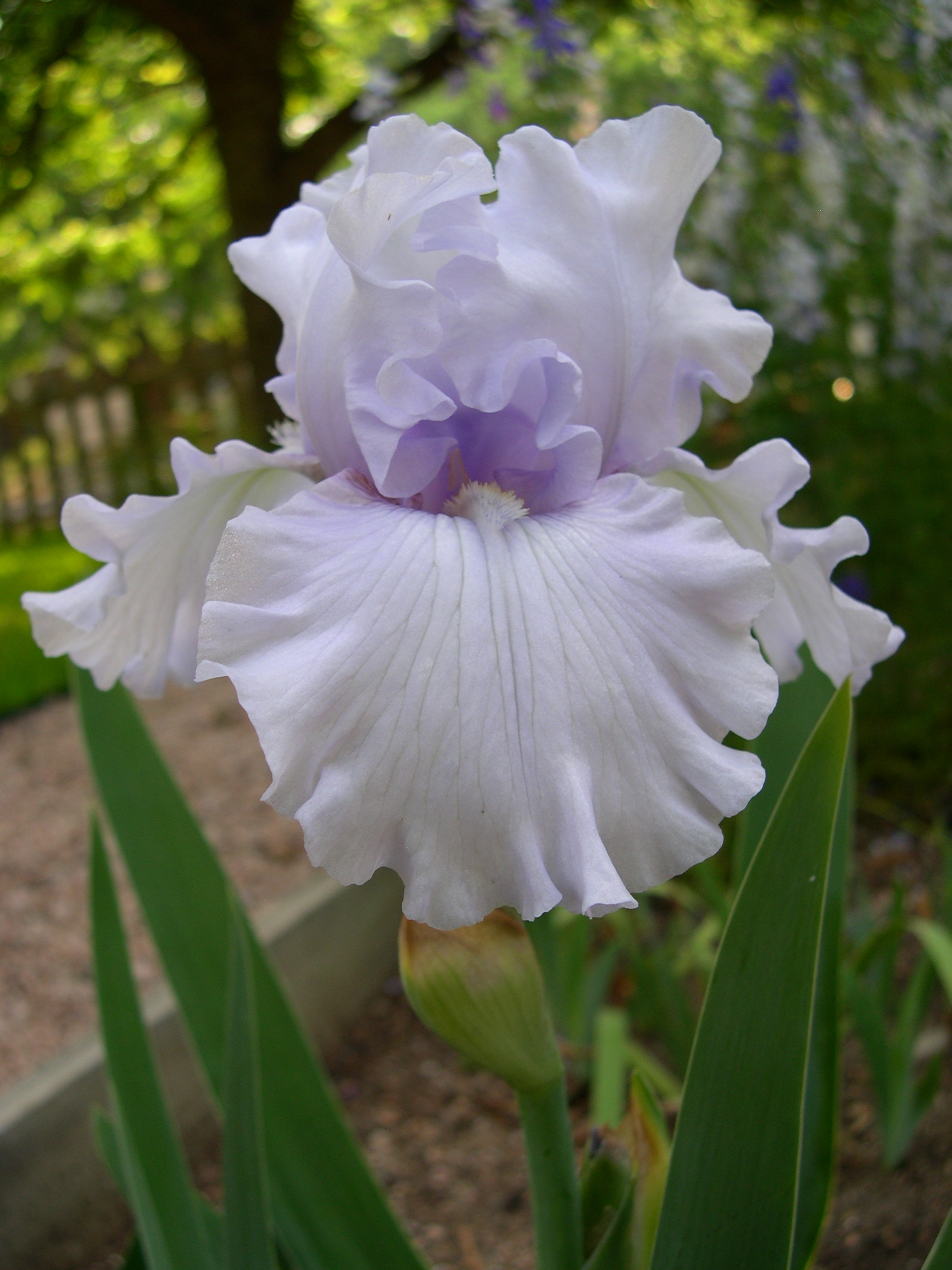
Iris ‘Silverado’

Two small stems of the bearded iris ‘Silverado’ bloomed for May Day. I want to say that ‘Silverado’ has never been very vigorous in my garden but photographic evidence contradicts me. Apparently I had quite a good stand of it in 2003 before I divided it and moved it. The three large rhizomes I’d bought from Schreiner’s Iris in 1999 had multiplied to 12 crowded small ones.

Schreiner’s bred ‘Silverado’ and introduced it to the iris world in 1987 where it took award after award, winning the highest honor, the Dykes Medal, in 1994. The color is the palest silvery blue with the slightest hint of lavender. The color glimmers in the mist or moonlight but washes out in glaring sunlight. The blooms are full and ruffled without the over-the-top frilliness of some modern irises. The standards and the falls are proportionately balanced.

Read the rest of this entry »

Week 18: May Day Pinks

Julie @ Human Flower Project passed along poppy seeds which finally started blooming this week. (Everyone else’s in Austin bloomed throughout April.) She said the double-selection was salmon. In soft early morning light it looked more dusty rose; in glaring afternoon light, definitely salmon. (These two photos are of the same flower taken about six hours apart.)

Papaver Dorothy Cavanaugh passalong

My love-in-a-mist, Nigella damascena had almost died out so, thinking I had enough blue flowers, I planted some ‘Mulberry Rose’ seeds from Renee’s Garden. The cilantro overgrew them and when I was clearing it out yesterday, I discovered these miniature nigella flowers, about the size of a dime, on teeny-tiny plants. (Seed packet: mature height 18-24 inches). Apparently they prefer room to grow.

Nigella damascena

On the opposite end of the scale, the unwieldy crinum (maybe Crinum bulbispermum) continue to flower. These large bulbs don’t like being moved and have taken about three years to settle in and start blooming.
Crinum

The pink rainlilies, Zephryanthes grandiflora opened all at once today. A single early flower opened on April 28th–but today is really rainlily day.

Zephyranthes grandiflora

Iris ‘Champagne Elegance’

Dateline: 2008-04-18

Did I move ‘Champagne Elegance’ as I chided myself to do in 2004? Why is my record-keeping so inconsistent? No, I chopped out the oregano instead. I had already moved her to the east square of the front lawn, a sunny spot where my plan was to plant roses and irises so that I could keep all the demanding plants together. The nearby Texas mountain laurel and oleander grew so quickly that this planned sunny spot was completely in the shade last year. So go my plans. As do my dreams of hundreds of irises multiplying exponentially.

Still ‘Champagne Elegance’ struggles on. Last year, Austin got twice as much rainfall in the summer as normal and I lost many bearded irises to rot. Only one rhizome of ‘Champagne Elegance’ survived. It produced three babies, each of which sent up a stalk and began flowering yesterday. Six small flowers in all. This is not a very impressive showing in the realm of tall beard iris fanciers but it pleases me.

Aren’t there certain flowers in your garden that make you run out when you spot them and whoop for joy? “Look! There’s ‘Champagne Elegance’ again’,” I insist, showing anyone who will stop and look.
Read the rest of this entry »

Hyacinthoides hispanica, Spanish Bluebells

The year we met, I planted bluebells for AJM to remind him of home. I know that when I was an ex-patriot, that I really missed the sheets of bluebonnets that signal spring to a Texan.

Now the bluebells I planted weren’t the wildlings of English woodlands, Hyacinthoides non-scripta; they were the larger, garden variety from Spain, Hyacinthoides hispanica. As it turned out, for many years Spanish bluebells were the variety preferred by English gardeners because the flowers are larger and form on both sides of the stem, and because the plants more vigorous. Apparently too vigorous. In recent years, concerns about invasive aliens interbreeding with the natives have raised alarms in England. The beloved native is threatened by a Spanish army breaching the garden walls.

This is not a problem in Central Texas so I grow my Spanish bluebells without guilt. They grow very well here, die down quickly after they bloom, and come back reliably without being aggressive.

Spanish bluebells
Spanish bluebells in Texas.

I finally got to see English bluebells in their native habitat when we drove down to Oxford and the Cotswolds a couple of years ago. Impressive. Sheets of blue. Just like bluebonnets!
English bluebells
English bluebells in England. I don’t know if the color is really that much deeper or if it’s just a trick of the light.

Rose ‘Souvenir de la Malmaison’

I love the cyclical nature of gardening. I’m amused to find myself taking photos of ‘Souvenir de la Malmaison’ as I did exactly one year ago. I wish I could put her on pause because today all her flowers are in full bloom and by tomorrow the petals will be scattered on the paths. And I really wanted Carol to see her. Ephemeral beauty. She’s bloomed non-stop all through March but she won’t make it to April. Fortunately ‘Blush Noisette’ is waiting in the wings to take the spotlight. Thus I am consoled.

Read the rest of this entry »

Aloe barbadensis, aloe vera

Like fellow Austin gardener, Rachel @ In Bloom, I’ve been enjoying the spiky blossoms of aloe vera this week.

They come as quite a surprise to me. I never knew that aloe vera bloomed. For years they did nothing but form more pups. Ever since my friend Dana shared a few pups with me, I’ve kept potting and repotting them until I had three pots so heavy that it took both of us to lug them indoors each winter. I’d read they were frost-sensitive.

In the summer of 2006, however, a construction worker knocked his ladder into one of the pots. I didn’t have another large pot for the three biggest plants so I stuck them in a empty bed until I could get one. I never got around to it. The aloe survived in a dark, dry place where nothing else grew. I liked their spare geometry.

Aloe vera

So I left them. I thought winter would kill them off but as I still had plenty of pups, I didn’t mind treating these three as annuals. Winter did not kill them off. Neither did a second winter. Both winters were mild and the aloe vera have the advantage of being planted in front of a stone wall which reflects heat. Had they been elsewhere in the yard I think I would have lost them. In places, the leaves took a reddish cast from cold damage. Earlier this month they sent up bloom stalks and finally last week the yellow flowers started opening.

Aloe vera

I quickly did some Google searches on “aloe, yellow flowers” and discovered that they are aloe vera (which is their common name), Aloe barbadensis being the botanical name, although there is a trend to use aloe vera for both.

Before I dragged the pots of aloe outside this week, I cut off two of the biggest stalks and stuck them in another dark, empty spot near the front fence. The pots have gotten too heavy for me to lift and the aloe seem to prefer being in the ground.

Update: 2016-11-05

The red-flowered Aloe arborescens is said by some to be the “true” aloe, the one with the most beneficial medical properties.

Update: 2018-03-17

I’ve decided to redo this bed from scratch.

The two hard freezes in January 2018 reduced this bed to pups. I had already hacked out the frozen tops. However, the pups were weak and not thriving. They are smothered by cedar elm leaves and I think I even put Christmas tree mulch in here one year.

Pulled 25 pups and potted 24 of them in the 4-inch pots. One was larger so I put it in a larget pot. (photos).

Strawberries, $5 a Bite

Last fall I read an article that Austinites could grow strawberries as annuals, planting them in the fall, pinching back all runners, and picking off flowers until mid-February. We were not to expect them to survive the summer but must be prepared to replant each fall. So when Margaret and I were at Gardens last October, I was so excited to see strawberry plants there that she bought me five plants (at $1.99 each).

Seeing the catalog prices for strawberry plants since then has made me realize these strawberries were quite expensive. However, they were the plants that were available here last October, ‘Sequoia’ variety grown in Texas at Gabriel Valley Farms.

So from our tiny strawberry patch of 5 plants, we just harvested our first strawberry. A $10 strawberry. (The more we harvest, the more the price will drop, but for now that is the cost of this harvest.) I waited until evening when AJM came home from work and we harvested it together. Then we carefully cut it in half with our sharpest paring knife. We each popped our share into our mouths and simultaneously exclaimed, “Mmmmm!” Wow! I think fresh from the garden strawberries might even be better than fresh from the garden tomatoes.

I hope our silly little strawberry patch graces us with more fruit. Now I have wild dreams of expanding my planting next fall but I will have to find a cheaper source of plants.

Hippeastrum papilio, butterfly amaryllis

The butterfly amaryllis is quite striking. I would say that it has been worth the wait, except…more than seven years! I’d love it just as much if it bloomed every year. Really, dear, I would.

amaryllis papillio

A native of Brazil, my butterfly amaryllis has never gone dormant, although it looks a bit ratty after a long, hot Austin summer. I’ve heard some advice that Austinites can plant them in the ground as we do our more hardy Hippeastrums, the St. Joseph’s lilies. I don’t think I’ll bet against the Texas weather.

Garden History

2000-11-05.
At Gardens buy the amaryllis that I first saw and liked in the Garden.com catalog. [2011-01-24. Maybe I actually got this from Dutch Gardens. I find a label for one with this description. Or maybe Gardens was carrying bulbs from Dutch Gardens.]

“Brightly striped maroon and ivory petals with a chartreuse background.”

2000-11-09.
Pot it, after soaking the bulb in sea weed mix.

2000-12-10.
First flower opens completely.

2000-12-17.
Last day of bloom.

2006-09-06.
Divide the butterfly amaryllis into two pots. It was incredibly pot bound. I’ve heard that they prefer to be pot bound, but I don’t think they mean like this. I had to rip out a lot of roots to separate them.
amaryllis papillio
2006-09-06. The butterfly amaryllis and three daughters sit on top of the pot they were in.

2008-03-12.
First flower.

Golden Barrel Cactus

My brother, MJN, introduced me to the gorgeously planted Springs Preserve in Las Vegas and there I fell in love with golden barrel cactus, Echinocactus grusonii. Although it is an endangered species in its native Mexico habitat, it is one of the most popular landscape cacti in the American Southwest. Apparently this cactus can reach a size four feet tall and three feet tall. However, in the many display gardens of the Springs Preserve, it was used as the desert equivalent of a small globe shaped boxwood.

golden barrel cactus
In another display bed, colorful recycled glass chips were used as a mulch. The resulting jewel like beds glittered in the desert sun, but like many rock/gravel/shell mulches, the glass chips ended up being strewn in the paths. Recycled glass is definitely not a mulch to use if you have lots of trees and leaf litter.

golden barrel cactus
Golden barrel cactus also filled planters lining the parking area at the entrance to the Springs Preserve. My mother fell in love with them, too, and so I bought her one for $20 at Lowe’s. Then I saw a little golden barrel cactus in a paper cup on the clearance table for $2. I had to have it even though everyone wondered how I’d get it home. (I put it in my carryon luggage. No problem.) The silly thing about my $2 cactus is that someone glued plastic eyes on it and the cup said, “My Peeps, Cactus Buddies”. Ugh! I’ll figure out how to cut off those cutesy plastic eyes and restore some dignity to my beautiful golden barrel cactus.

California Poppy ‘Mikado’

One trouble with Spring in Austin is that when the trees start budding and the gardener feels that irresistible pull into the garden, it is already too late to start lots of plants from seed. I haven’t made a seed order yet, (I was too busy in the garden to look at seed catalogs in December and January) and already the spring plants are blooming. Arg!

Today (3/4), the first flower of the California poppies, Eschscholzia californica, opened. The flower is about twice as large as last year’s but then it’s blooming almost three months earlier. Given that this plant is one that oversummered, I consider this the “correct” time for California poppies to be blooming in Austin.

Last year (2007) I didn’t plant any California poppy seeds until the middle of January and those plants didn’t flower until late May. This year (2008) I was even later getting my seeds started. Those seedlings are up but I haven’t started transplanting them yet and here last year’s flowers are already blooming. So I better get busy.

Although the seed packet claims that California poppies “reseeds easily”, I’ve haven’t had much luck with them self-sowing. However they are very easy to sprout from seed which is much larger than other types of poppies. Now if I could remember to get them started earlier…

Garden History

2007-01-12.
Plant California poppy ‘Mikado’.

2007-01-30.
California poppies sprouting.

2007-02-21.
Begin transplanting California poppy seedlings. Because they have a long taproot, California poppies don’t like being transplanted. But they were only two inches tall when I moved them and watering them well at first helped almost all of them to survive.

2007-05-24.
Finally, two flowers on my California poppies opened today. The flower are quite small, not much bigger than a thimble. I planted them way too late for Austin (January 12th). They didn’t sprout until January 30th.

Zanthan Gardens California Poppy
2007-05-24. California poppy ‘Mikado’.

Here’s a factoid to demonstrate how late I was getting these in this year; in 1998, when I tried ‘Mission Bells’, they began blooming on February 28th.

2008-02-05.
Discovered that there were still plenty of seeds left in last year’s seed packet and sowed three rows. There are still seeds left! Several plants from last year survived the summer and just in the last month or so have been putting on a lot of growth.

2008-03-04.
First flower on a plant that over-summered. California poppies are perennials but they don’t usually survive Austin’s summers in my garden. The poppies I planted in February are just getting their true leaves and only two inches tall. Despite my springtime urges, spring is too late to plant California poppies in Austin.

2008-10-10.
Plant California poppies ‘Mikado’. I always start these too late (like Jan). The ones that flowered last spring overwintered. Start earlier.

2008-12-19.
Transplant a dozen California poppy ‘Mikado’ seedlings that I started on 2008-10-10. All that’s left from squirrels digging in the seedbed. Note: They always look to small and crowded to transplant. Wait until they have a few true leaves and are two to three inches across–later than for larkspur or bluebonnets. Don’t worry about crowding or thinning.

2009-01-01.
California poppy transplants have recovered and it has also self-sown, a first for me.